Soar, ACT-R & blackboards
Shared state, specialized processes, procedural learning, and Soar’s chunking already establish key precedents.
A systems hypothesis: agents may preserve performance while reducing autoregressive reasoning by using machine-facing semantic decisions, typed state, and governed reusable fast paths.
This work presents an architectural hypothesis and proposed experimental framework. It does not claim experimental validation.

Contemporary LLM agents often serialize internal coordination and reasoning through natural language. A model plans, narrates a tool call, interprets textual results, restates state, and repeats.
Language remains indispensable at the human interface. But using it as the default internal computational protocol is an engineering choice—not an axiom.
state → LLM → reasoning text → tool → textual observation → LLM → …
Logic gates map signals to deterministic outputs. A semantic gate would map state to a constrained, learned probability distribution—context-dependent, fallible, but directly usable by software.
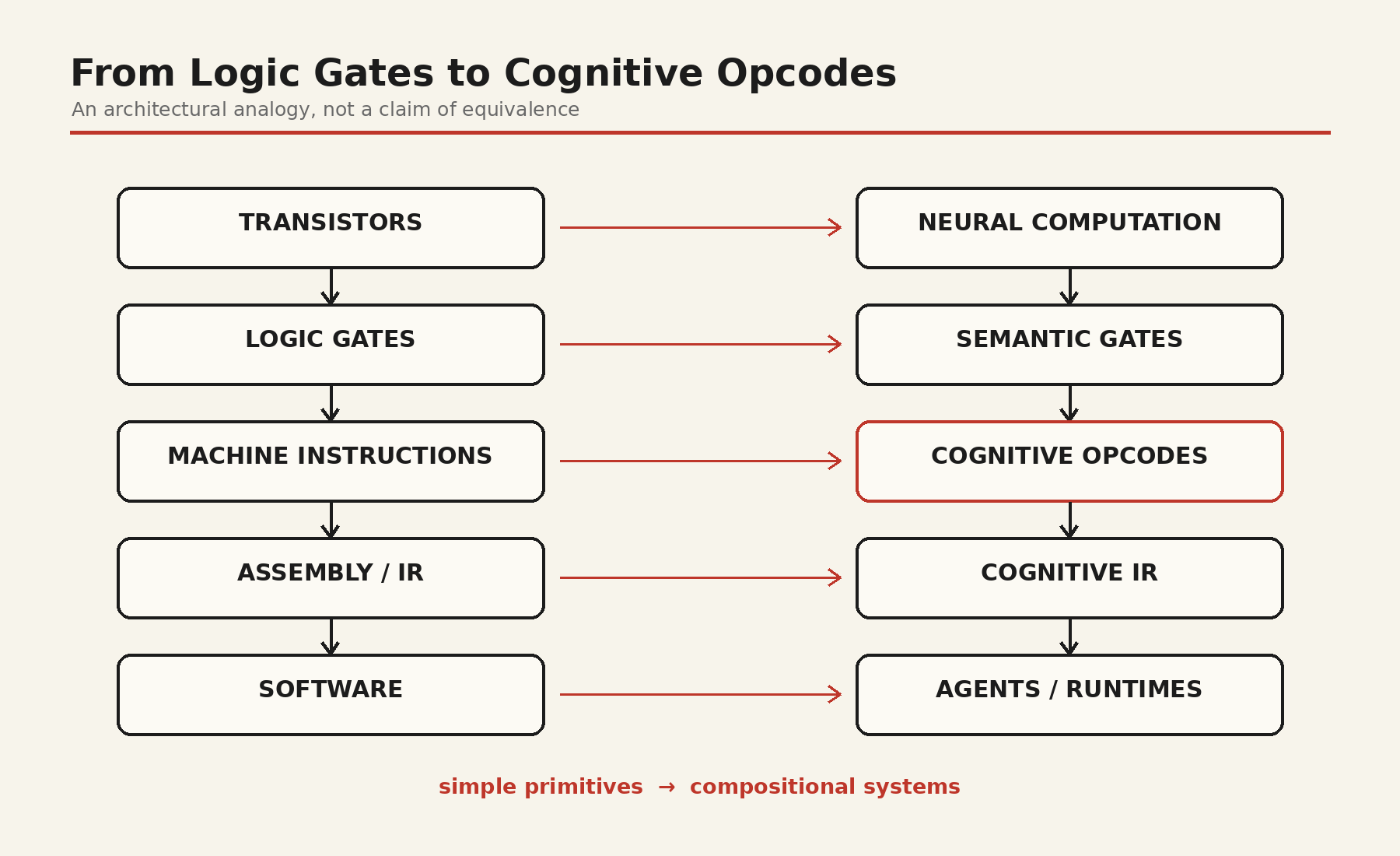
FIG. 01 — The computing stack
These names are illustrative, not a proposed standard. The research question is which operations are general, separable, calibratable, and composable enough to justify becoming primitives.
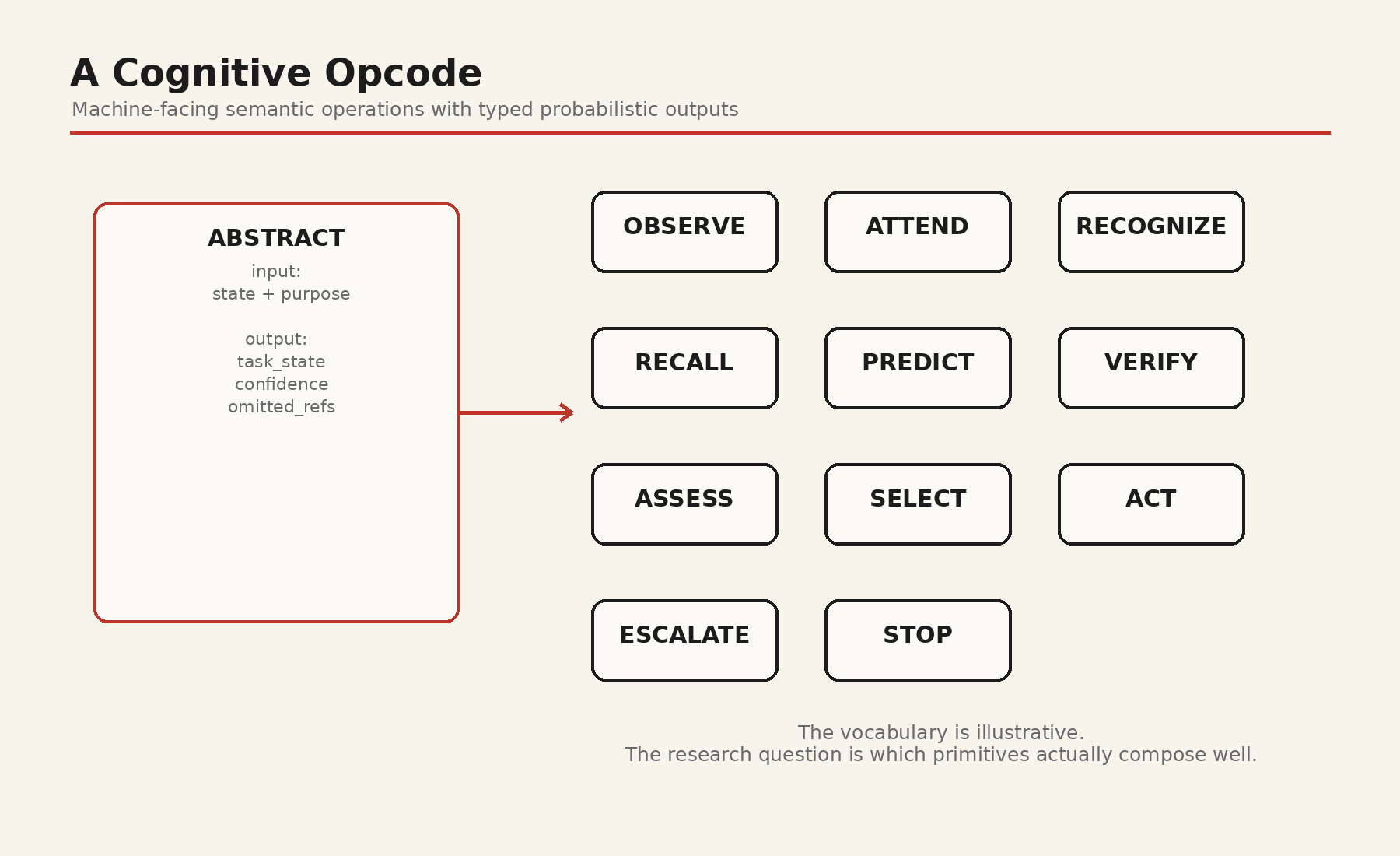
FIG. 02 — A cognitive opcode
“The test failed because the expected key was 9000 but the loop only produced values through 8999. This looks like an off-by-one error.”
OBS[test=T17,status=FAIL]
EXPECT[key=9000]
OBSERVED[max_key=8999]
HYP[off_by_one=.97]
NEXT[inspect:loop_boundary]
A production implementation could use typed objects, latent state, or a hybrid. The point is not the syntax: human-readable prose is not required at every internal boundary.
Intent, relevance, novelty, risk, memory matches, progress, tool requirements, uncertainty, and language can be evaluated in parallel. Components may be deterministic code, learned classifiers, vision encoders, retrieval systems, specialist models, or a general reasoner.
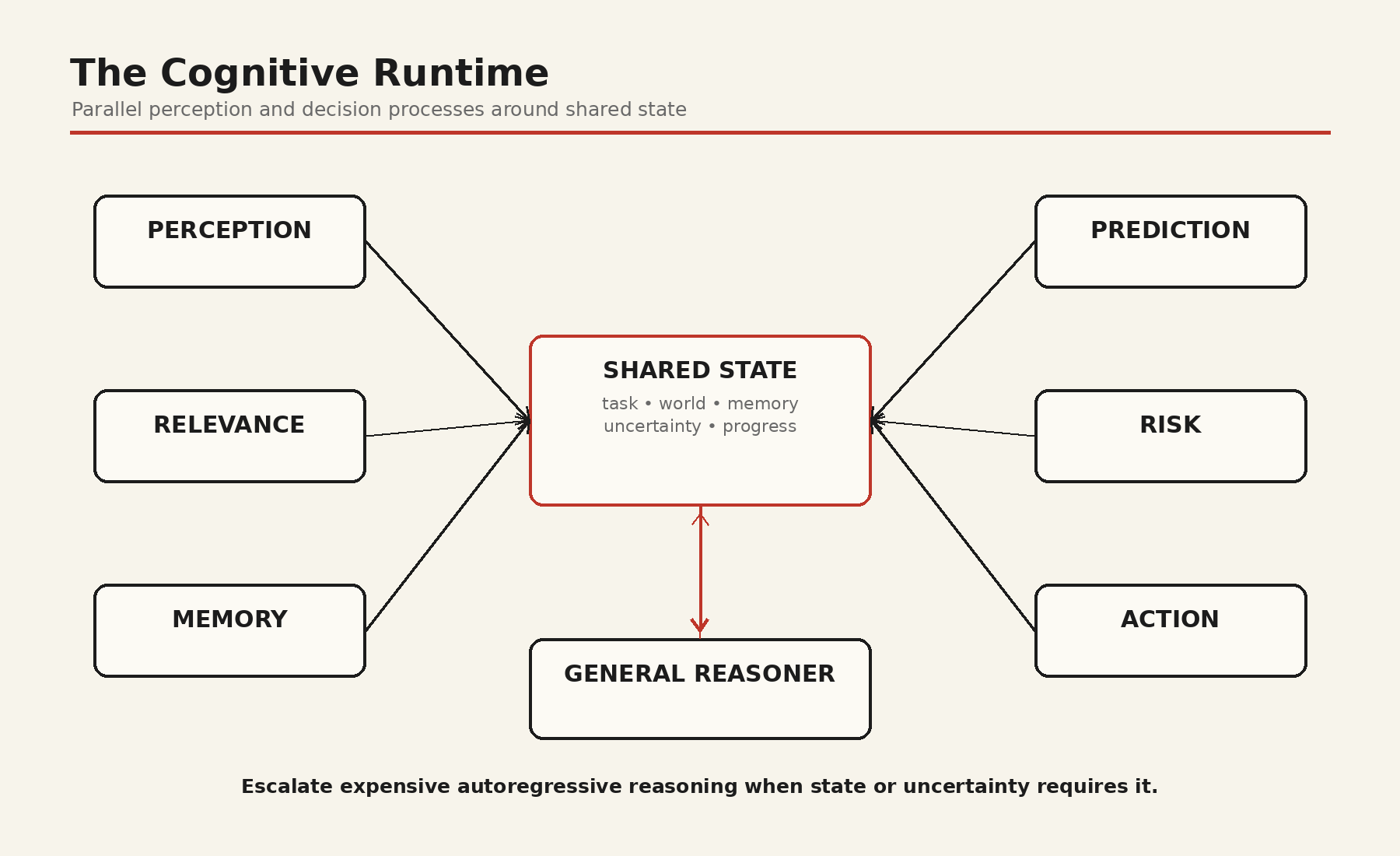
FIG. 03 — The graph, not any single model, becomes the intelligent system.
Goals, entities, evidence, memory references, progress, and uncertainty.
Confidence, entropy, abstention, and calibration drive escalation and policy.
Invoke expensive language reasoning only when the state actually demands it.
This is not merely caching. A promoted fast path must have defined validity conditions, calibration behavior, versioning, test coverage, monitoring, and a reversible rollback path.
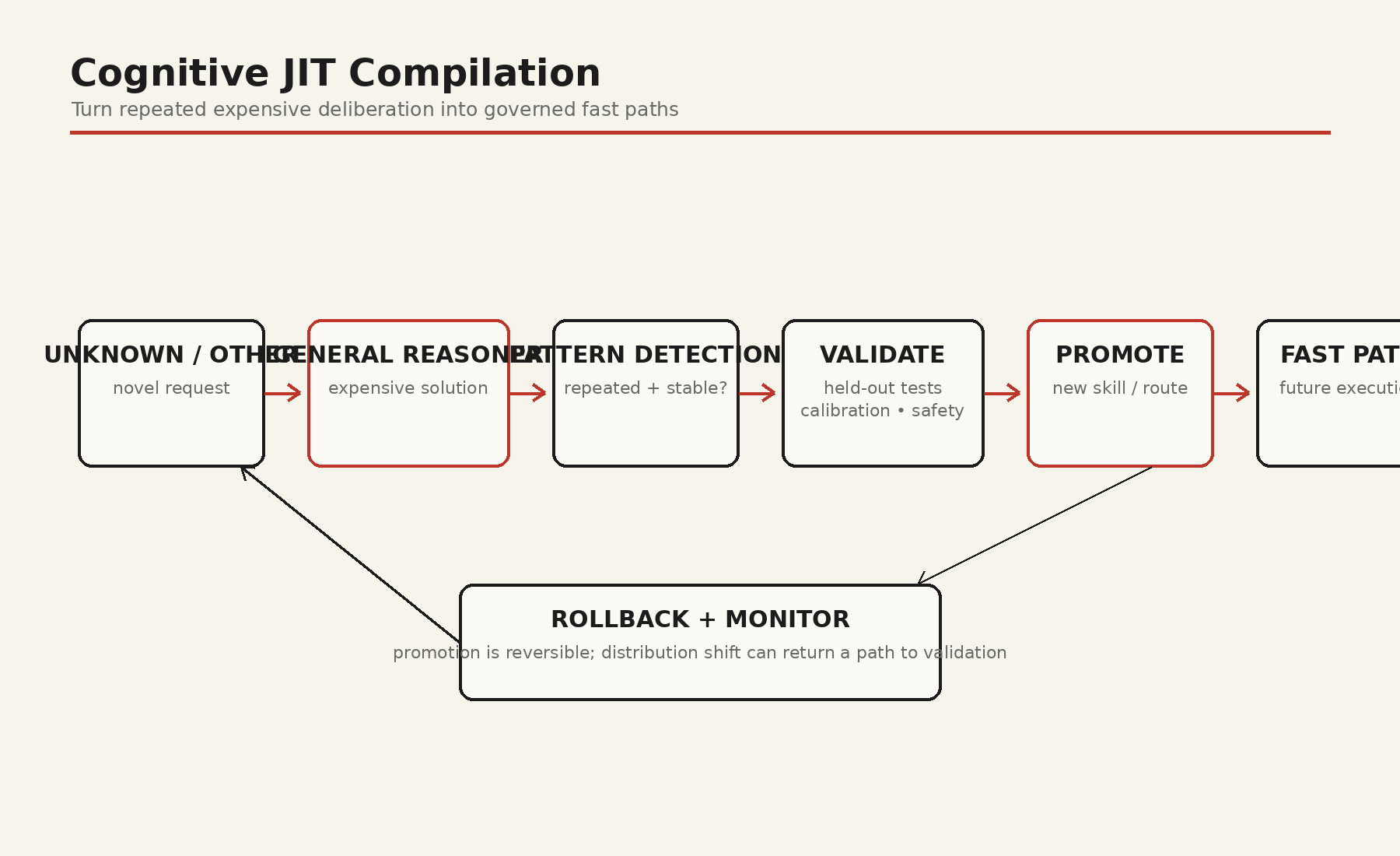
FIG. 04 — Compilation is a governed lifecycle, not a shortcut around evaluation.
Individual ingredients have substantial prior art. This proposal does not claim to invent modular cognition, latent reasoning, cognitive architectures, or compilation of deliberation. Its proposed research direction is their combination:
Shared state, specialized processes, procedural learning, and Soar’s chunking already establish key precedents.
Neural Programmer-Interpreters and Neural Module Networks show reusable, compositional computation.
Temporally extended actions with initiation conditions and termination are direct precedents for abstraction over action.
LLMs as components within larger systems, able to reason, act, and use specialized external capabilities.
Programming models and compilation for LM pipelines—not merely ad-hoc prompt strings.
Experience can accumulate as executable, retrievable, and refinable skills.
Reasoning need not be decoded into ordinary language at every intermediate step.
A timely System-One-style primitive: machine-facing distributions rather than generated strings. Its architectural claims remain vendor claims.
See the supported bibliography and the full paper for precise distinctions and links.
Compare a conventional reasoner/tool loop against a cognitive runtime that uses a machine-facing state layer and cheap semantic decisions before and after expensive reasoning. Escalate only for uncertainty, novelty, or policy.
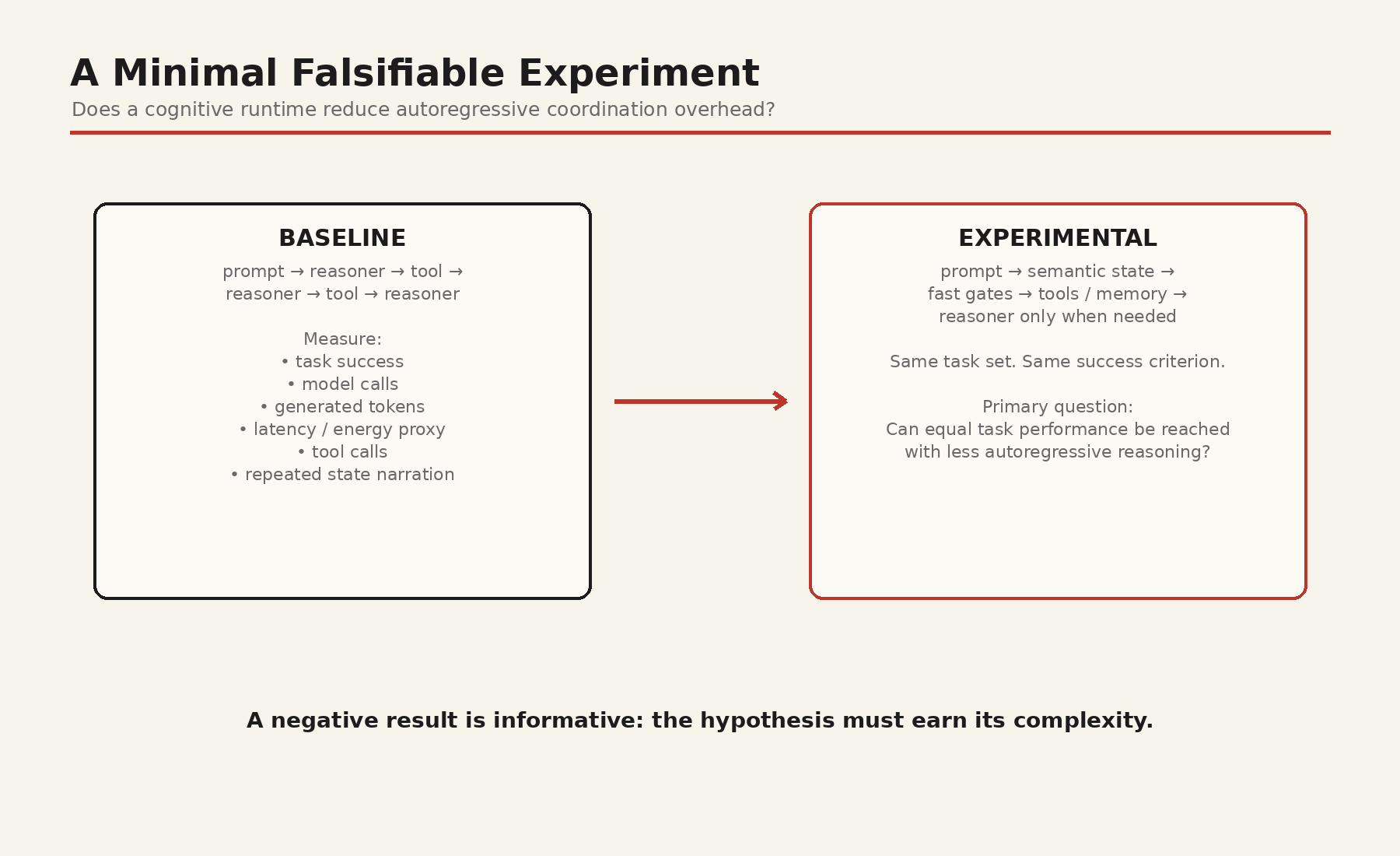
FIG. 05 — A minimal experiment does not require a new foundation model.
The paper contains the complete argument, prior-art discussion, scope note, and references.